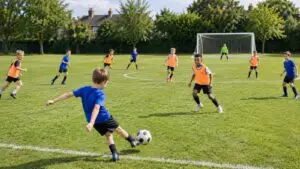
Understanding primary school football rules helps teachers, coaches and parents prepare children for competitive matches.
Although both seven-a-side and nine-a-side football share the same fundamental principles, there are important differences in team sizes, match durations and competition formats.
The Lambeth & Southwark Primary Schools Football League operates Girls 7v7 and Mixed 9v9 competitions for participating schools.
Here is what schools need to know.
What Is 7v7 Football?
Seven-a-side football involves seven players from each team on the pitch, including the goalkeeper.
Within the Lambeth & Southwark league, this format is used for the dedicated girls’ competition.
The smaller team size creates opportunities for players to become involved in different aspects of the game, from defending and passing to attacking.
According to the league’s published 2025/26 competition rules, girls’ 7v7 matches last 40 minutes, plus any stoppage time.
Schools can find competition information through the Girls 7v7 League.
What Is 9v9 Football?
Nine-a-side football involves nine players per team, including the goalkeeper.
The league uses this format for its mixed competition, allowing boys and girls to represent their schools together.
With additional players on the pitch, children experience more opportunities to develop positional awareness, teamwork and tactical understanding.
The league’s published rules specify 50-minute matches for mixed 9v9 football, plus stoppage time.
Visit the Mixed 9v9 League for information about its divisions and fixtures.
Key Differences Between 7v7 and 9v9 Football
The league’s published 2025/26 rules identify several important differences.
| Rule | Girls 7v7 | Mixed 9v9 |
|---|---|---|
| Players per team | 7 | 9 |
| Match duration | 40 minutes | 50 minutes |
| Minimum players to start | 5 | 6 |
| Rolling substitutions | Permitted | Permitted |
| Heading | Not permitted | Not permitted |
Both formats provide structured opportunities for children to participate in competitive school football.
However, schools should always refer to the latest official rules rather than assuming every local competition follows identical arrangements.
Important Safety Rules for School Football
Player safety is a central consideration in primary school football.
The league’s published competition rules require players to wear appropriate footwear and suitable shin guards.
Jewellery and watches are not permitted on the field of play, while goalkeepers should wear appropriate gloves.
The rules also prohibit heading the ball during matches.
These requirements help establish clear expectations for participating schools and their players.
Teachers and coaches should ensure children understand the rules before arriving at a fixture.
Substitutions and Player Participation
Rolling substitutions are permitted in both league formats, subject to the referee’s permission.
This means a player who leaves the pitch may return later in the match.
Such arrangements give coaches flexibility when managing their teams and provide opportunities to involve substitutes.
Coaches should plan substitutions carefully and communicate clearly with players throughout the match.
Fair Play and Positive Behaviour
Football rules are not only about what happens when the ball is in play.
The league also sets expectations for coaches, team managers, players and spectators.
Schools are responsible for behaviour during fixtures, while referees have authority to manage misconduct.
Encouraging respect for opponents and match officials helps create a positive sporting experience.
Where Can Schools Find the Official Rules?
Competition arrangements may change between seasons, so schools should check the current regulations before participating.
Read the league’s official competition rules for full details of match requirements, safety procedures and participation.